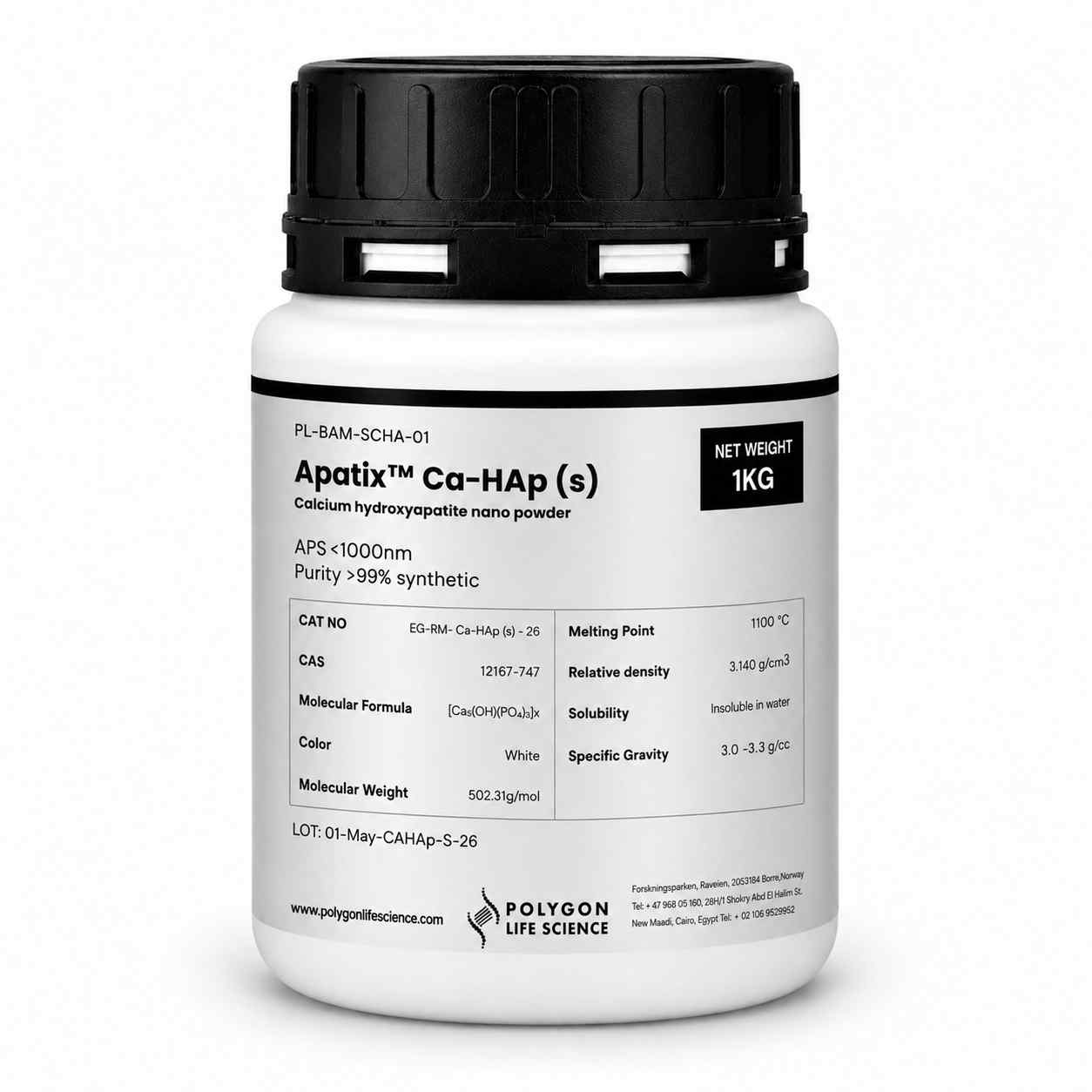
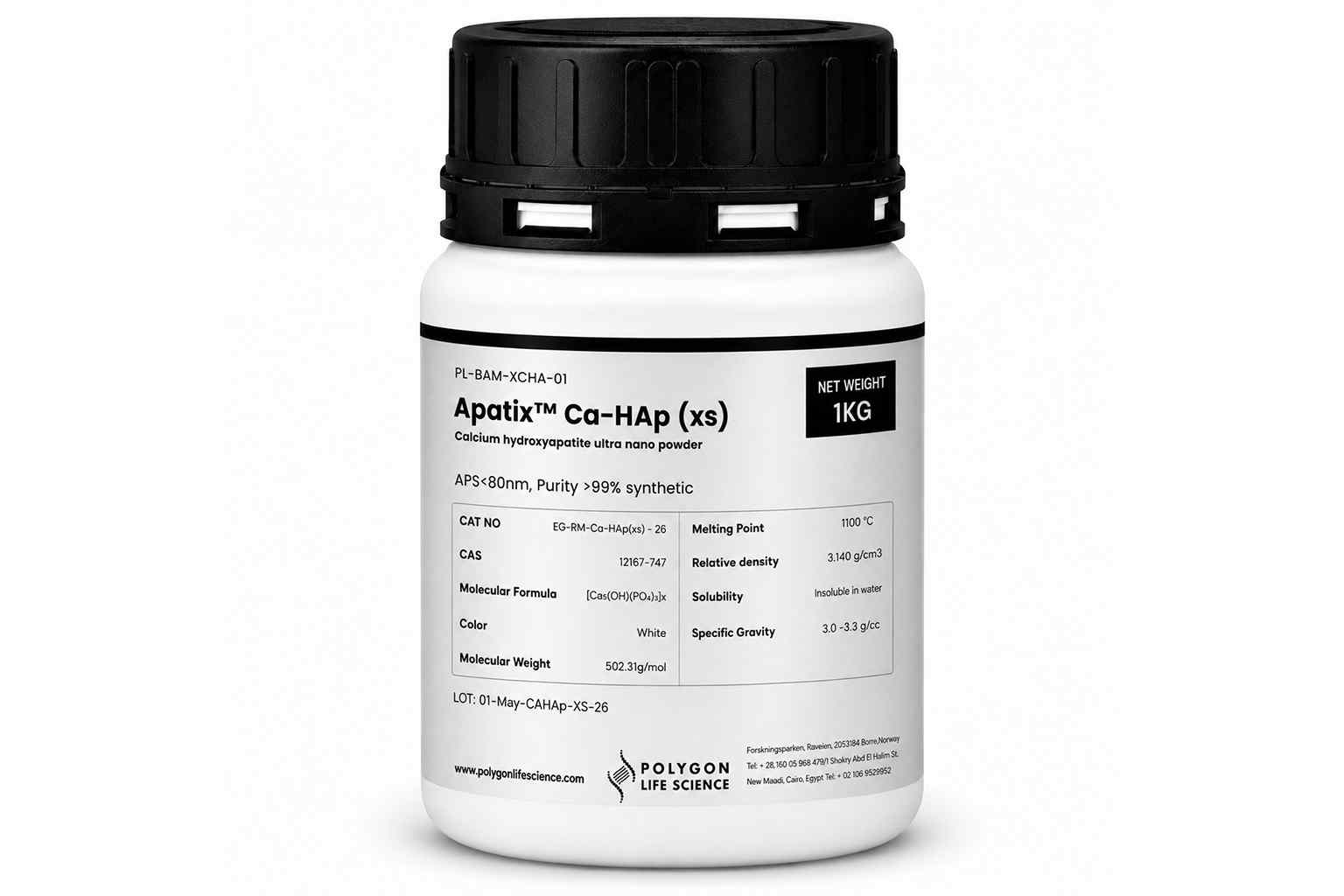
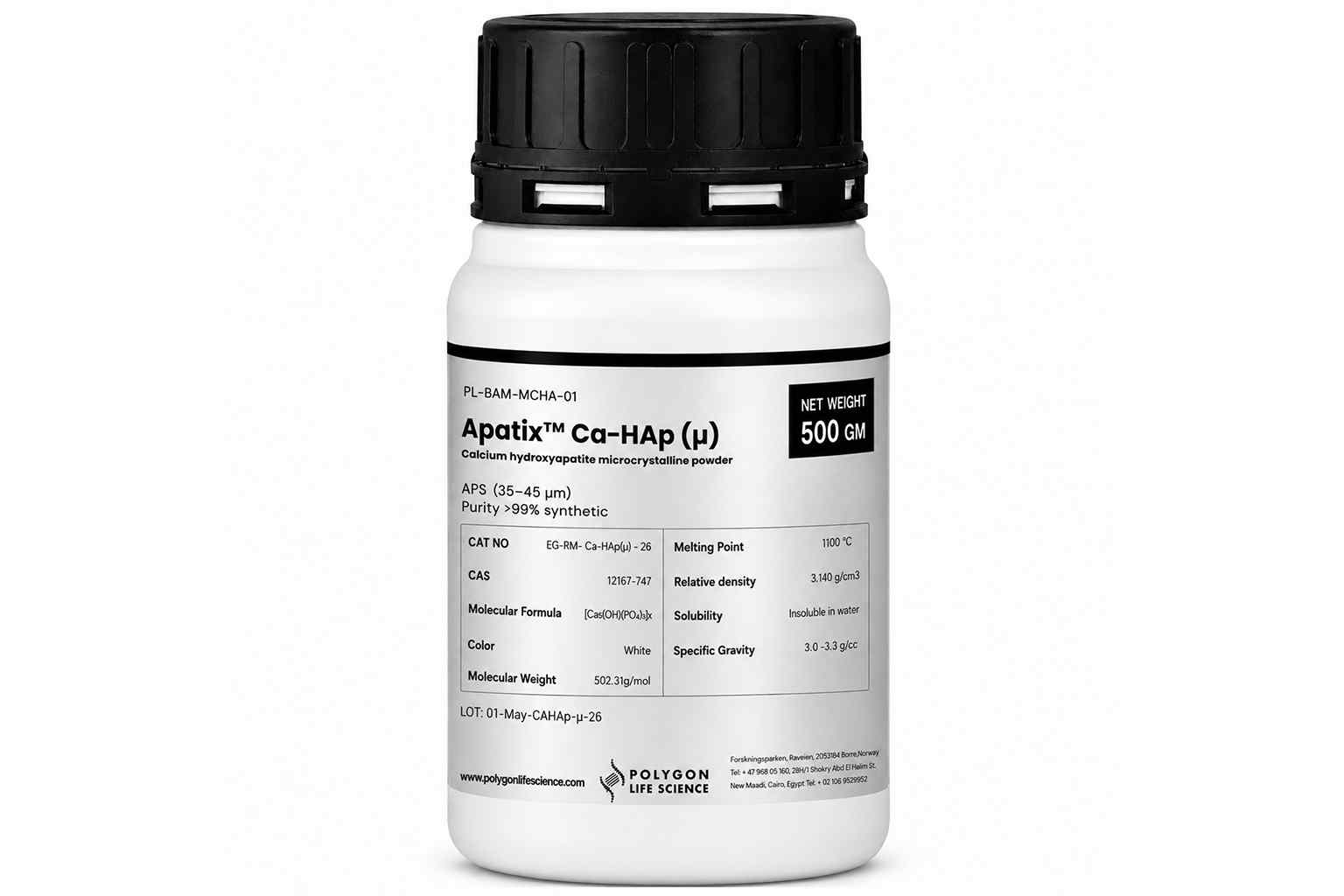
Nano Calcium Hydroxyapatite (CaHA) is a biomimetic calcium phosphate nanomaterial engineered with particle size below 1000 nm. is a highly biocompatible biomaterial designed for dental, orthopedic, cosmetic, and composite applications. It offers balanced bioactivity, controlled surface reactivity, and improved processing behavior compared with ultra-nano materials. Its composition closely resembles natural hard tissue minerals, enabling excellent compatibility with biological systems and polymeric matrices.
Certificate of Analysis (CoA), Safety Data Sheet (SDS), Specification Sheet
PREPARATION / RECONSTITUTION
General Guidance
Disperse slowly into deionized water under stirring.
Recommendations
Use sonication for uniform dispersion and avoid excessive heat.
MECHANISM & BIOLOGICAL FUNCTION
Mechanism of Action
Promotes calcium phosphate deposition and enhances biomaterial integration through osteoconductive activity..
Biological Claims
Enhances remineralization, improves scaffold compatibility, and supports tissue repair processes.
APPLICATIONS
Intended Uses
Bone tissue engineering, injectable regenerative fillers, mineral sunscreen, remineralizing toothpaste, drug delivery systems, anti-aging cosmetic formulations and bioactive coatings.
PACKAGING & PRESENTATION
Sizes
1 kg
500 g
Apatix™ Ca-HAp (s)
FEATURES AND KIENTICS
Particle size below 1000 nm
Biomimetic composition similar to bone mineral
Moderate surface area
High chemical stability
Good suspension behavior
Excellent biocompatibility
Mechanism of Action
1
Biomineralization Mechanism
2
Surface Filling Mechanism
3
Scaffold Interaction Mechanism
What's inside ?
Biomimetic composition similar to bone mineral
High chemical stability
Good suspension behavior
Moderate surface area
Excellent biocompatibility
Particle size below 1000 nm
Available Dosage Forms
Injection
Tablets\Supplement
Topical
Related Products
Explore related products
Bioactive materials
Apatix™ Ca-HAp (xs)
Ultra Nano Calcium Hydroxyapatite (CaHA) is a biomimetic calcium phosphate nanomaterial engineered w...
What is the advantage of APS <1000 nm over micro-sized CaHA?
Better bioactivity, higher surface area, and improved cellular interaction.
Is nano CaHA useful in toothpaste?
Yes, it helps remineralize enamel and reduce dentin hypersensitivity.
How does CaHA support bone regeneration?
CaHA nanoparticles promote bone tissue integration and growth which makes them perfect for bone defect treatment and regenerative applications in both orthopedic and dental fields.